Archive for the ‘Humor’ Category

NSA — Untangling the Web: A Guide to Internet Research

Wednesday, May 15th, 2013

NSA — Untangling the Web: A Guide to Internet Research

A Freedom of Information Act (FOIA) request caused the NSA to disgorge its guide to web research, which is some six years out of date.

From the post:

The National Security Agency just released “Untangling the Web,” an unclassified how-to guide to Internet search. It’s a sprawling document, clocking in at over 650 pages, and is the product of many years of research and updating by a NSA information specialist whose name is redacted on the official release, but who is identified as Robyn Winder of the Center for Digital Content on the Freedom of Information Act request that led to its release.

It’s a droll document on many levels. First and foremost, it’s funny to think of officials who control some of the most sophisticated supercomputers and satellites ever invented turning to a .pdf file for tricks on how to track down domain name system information on an enemy website. But “Untangling the Web” isn’t for code-breakers or wire-tappers. The target audience seems to be staffers looking for basic factual information, like the preferred spelling of Kazakhstan, or telephonic prefix information for East Timor.

I take it as guidance on how “good” does your application or service need to be to pitch to the government?

I keep thinking to attract government attention, an application needs to fall just short of solving P = NP?

On the contrary, the government needs spell checkers, phone information and no doubt lots of other dull information, quickly.

Perhaps an app that signals fresh doughnuts from bakeries within X blocks would be just the thing. ;-)

Beer Mapper

Thursday, May 2nd, 2013

Beer Mapper: An experimental app to find the right beer for you by Nathan Yau.

Beer map

Nathan reviews an app that with a data set of 10,000 beers, attempts to suggest similar beers based on your scoring of beers.

A clever app but I am betting on Lars Marius besting it more often than not!

What is The ROI of Ignorance?

Friday, April 26th, 2013

What is The ROI of Ignorance? by Timo Elliott.

Some quants will be disappointed but it’s a fair estimate:

Ignorance ROI

Serious Topic Maps Avoid CNN

Friday, April 19th, 2013

The topic map committee choose to not provide guidance on creating topic maps.

In hindsight, I think that was a mistake. A big one.

How else can users know to avoid CNN.com when creating serious topic maps?

Instead of ISO/IEC SC34/WG3, people have to rely on Jon Steward to get that information:

Jon Stewart Rips Into CNN For Lying About The Boston Marathon

I like Jon Stewart but an SDO he’s not. I doubt he is even a member of a national body.

I can imagine using CNN for a topic map, one about sexual graffiti in the catacombs of Rome being investigated by Geraldo Rivera.

And for a topic map on the descent of journalism into 24×7 infotainment.

But outside of that…, not a chance!

Big Data Defined

Thursday, April 4th, 2013

Big Data Defined by Russell Jurney.

From the post:

Specifically, a Big Data system has four properties:

  • It uses local storage to be fast but inexpensive
  • It uses clusters of commodity hardware to be inexpensive
  • It uses free software to be inexpensive
  • It is open source to avoid expensive vendor lock-in

It has been raining all day but I had to laugh when I saw Russell’s definition of “a Big Data system.”

Does it remind you of any particular player in the Big Data pack? ;-)

That’s one way to build marketshare, you define yourself to be the measuring stick.

Let’s walk through the list and see what comments or alternatives suggest themselves:

  • It uses local storage to be fast but inexpensive

    [What? No cloud? Have you compared all the cost of local hardware against the cloud?]

  • It uses clusters of commodity hardware to be inexpensive

    [Wonder why NCSA build Blue Waters "from Cray hardware, operates at a sustained performance of more than 1 petaflop (1 quadrillion calculations per second) and is capable of peak performance of 11.61 petaflops (11.6 quadrillion calculations per second)." Must not be "big data.]

  • It uses free software to be inexpensive

    [They say that so often. I wonder what they are using as a basis for comparison? LaTeX versus MS Word? Have you paid anyone to typeset a paper in LaTeX versus asking your staff to type it in MS Word?]

  • It is open source to avoid expensive vendor lock-in

    [Actually it is open formats that avoid vendor lock-in, expensive or otherwise]

I enjoy a bit of marketing fluff as much as the next person but it should at least be plausible.

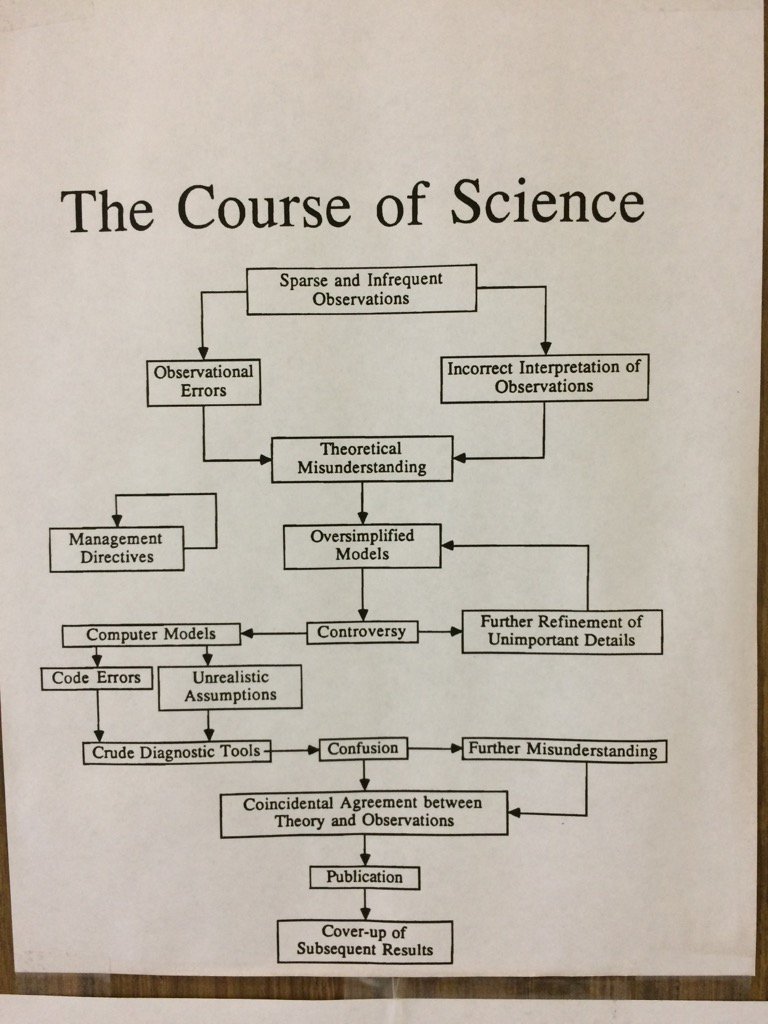
Interpreting scientific literature: A primer

Sunday, February 17th, 2013

Interpreting scientific literature: A primer by kshameer.

It’s visual so follow the link.

I shouldn’t re-post this sort of thing, being something of a professional academic, but it’s too funny to resist.

Would be interesting to create an auto-tagger that could be run against online text to supply markup with the “they mean” values to be displayed on command.

;-)

I first saw this at Christophe Lalanne’s A bag of tweets / January 2013.

Bacon, Pie and Pregnancy

Sunday, February 10th, 2013

Searching for “Biscuit Bliss,” a book of biscuit recipes, also had the result:

People also search for

The Glory of Southern Cooking James Villas

The Bacon Cookbook James Villas

Texas home cooking Cheryl Jamison

The Joy of Pregnancy

Pie Ken Haedrich

If I were writing associations for “Biscuit Bliss,” pie would not make the list.

Bacon I can see because it is a major food group along side biscuits.

I suppose the general cooking books are super-classes of biscuit making.

Some female friends have suggested eating is associated with pregnancy.

True, but when I search for “joy of pregnancy,” it doesn’t suggest cookbooks in general or biscuits in particular.

If there is an association, is it non-commutative?*

Suggested associations of biscuits with pregnancy? (mindful of the commutative/non-commutative question)


* I am not altogether certain what a non-commutative association would look like. Partial ignorance from a point of view?

One player in the association having knowledge of the relationship and the other player does not?

Some search engines already produce that result, whether by design or not I don’t know.

When Oracle bought MySQL [Humor]

Wednesday, February 6th, 2013

When Oracle bought MySQL from DBA Reactions.

Start your topic map day’s reading with some humor!

More seriously, suggestions of pics or video clips with topic map related captions welcome! (for the renovated topicmaps.com).

If we can’t smile at ourselves, very few are going to smile on us.

DBA Reactions [Humor]

Monday, February 4th, 2013

DBA Reactions [humor]

You may not like every post but several are keepers.

I have mixed feeling about the auto-replay. Once is enough for many of them.

Enjoy!

PS: One where the replay works is: When I see the developers using an ORM and it actually performs well.

Bad News From UK: … brows up, breasts down

Tuesday, January 29th, 2013

UK plastic surgery statistics 2012: brows up, breasts down by Ami Sedghi.

From the post:

Despite a recession and the government launching a review into cosmetic surgery following the breast implant scandal, plastic surgery procedures in the UK were up last year.

A total of 43,172 surgical procedures were carried out in 2012 according to the British Association of Aesthetic Plastic Surgeons (BAAPS), an increase of 0.2% on the previous year. Although there wasn’t a big change for overall procedures, anti-ageing treatments such as eyelid surgery and face lifts saw double digit increases.

Breast augmentation (otherwise known as ‘boob jobs’) were still the most popular procedure overall although the numbers dropped by 1.6% from 2011 to 2012. Last year’s stats took no account of the breast implant scandal so this is the first release of figures from BAAPS to suggest what impact the scandal has had on the popular procedure.

Just for comparison purposes:

Country Procedures Population Percent of Population Treated
UK 43,172 62,641,000 0.00068%
US 9,200,000 313,914,000 0.02900%

Perhaps beauty isn’t one of the claimed advantages of socialized medicine?

How long is too long? Not long enough? Just right? (updated)

Wednesday, January 2nd, 2013

How long is too long? Not long enough? Just right? (updated) by Karen Suhaka.

From the post:

A little frivolous confection for your holiday enjoyment: comparing how long bills are in different states. Thanks to Rich for a lovely job on the maps, as usual.

As a first comment, the average word length across the country of words in bills is 6.16 letters, vs about 5 letters in common writing. Given the technical language, one would certainly expect words to be longer on average, and 20% longer seems reasonable. But really I wanted to compare how long bills were, in word count, not in letter count. To start with, let’s simply look at the average length length of bills (in words) by state. I was quite surprised by the variation between states. Ohio bills are, on average, longer then bills in Tennessee, by almost 500 words!

Interesting visualization of the word length of legislation, state by state in the United States.

I suspect your observations about word length and states will be more pointed than mine.

Intro to Cypher Console [Live Party Friend of Friend Graph?]

Friday, December 21st, 2012

Intro to Cypher Console by Peter Neubauer.

Peter has posted a 5 minute video introduction to the Cypher console.

Imagine a dynamic a friend of a friend graph for a Christmas or New Year’s party. Updated every 5 minutes and projected on a big screen.

Or you could allow guests to attach comments to the nodes/edges.

Rife with opportunities for humor. ;-)

Google Imagines a Real World That’s as Irritating as the Internet

Tuesday, December 18th, 2012

Google Imagines a Real World That’s as Irritating as the Internet by Rebecca Cullers.

From the post:

Google Analytics has put together a series of videos demonstrating what poor web design can do to an online commerce site—crap we’d never put up with in a brick-and-mortar store. There’s unintuitive search and site design that prevents you from finding the item you’re looking for—in this case, it’s a grocery store that makes it impossible to find an everyday item as simple as milk. There’s the obnoxious online checkout, where you’re forced to log in, agree to terms and prove you’re a real person before you get timed out, forcing you to start all over again. Then there’s a misplaced dig at Amazon’s highly successful, often copied suggestion of other items you might like. Produced in-house by Google Creative Lab, all the spots have the absurdity of a Monty Python skit. It seems weird for Google to be dissing online search and e-commerce, but here it serves the greater goal of telling people to learn more about their customers via Analytics. And in this case, it’s funny cause it’s true.

I won’t even attempt to describe the videos.

You will have to hold onto your chair to remain upright.

Seriously, they capture the essence of bad online shopping experiences.

Or should I say user interfaces?

D3 Replusive

Thursday, December 13th, 2012

D3 Replusive

An unlikely key sequence that triggers this behavior in a graph interface to a topic map could be quite amusing. ;-)

I first saw this in a tweet by Christophe Viau.

“I Have Been Everywhere” by Johnny Cash

Monday, December 3rd, 2012

A Real-Time Map of the Song “I Have Been Everywhere” by Johnny Cash

From the post:

Freelance web developer Iain Mullan has developed a map mashup titled “Johnny Cash Has Been EVERYWHERE (Man)!” [iainmullan.com].

The concept is simple yet funny: using a combination of an on-demand music service, an online lyrics catalog and some Google Maps programming magic, all the cities mentioned in the song are displayed simultaneously as they are mentioned during the song, as performed by Johnny Cash.

Some maps are meant to amuse.

BTW, Johnny prefers Safari or Chrome (as in won’t work with FireFox and I suspect IE as well).

Dereferencing Issues

Wednesday, November 28th, 2012

Robert Cerny, a well known topic map maven, tweeted his favourite #GaryLarson cartoon, this one on dereferencing:

Dereferencing

Semantic Web Explained

Wednesday, November 28th, 2012

Inge Hendriksen tweets: “The #SemanticWeb explained in a single cartoon frame…

Data Gift Guide

Tuesday, November 27th, 2012

Data Gift Guide by Nathan Yau.

From the post:

Now that we’re done giving thanks for all the intangibles like love, friends, family, and drunkenness, it’s time to turn our attention to the physical objects we don’t have yet. It’s the most wonderful time of year! Here are gift ideas for your data geek friends and family. A few of these take a while to make, so be sure to order them now so that you get them in time for Christmas.

Nathan has collected some interesting sources of gifts for the season.

From things I have never wondered about, pillows shaped like statistical distributions, to the more familiar books and electronics.

I mention this in lieu of any topic map specific gift sources that come to mind. Perhaps that will be different by next Christmas!

One possibility: Instead of a book of politicians and their dumb ideas, what if you had a book of dumb ideas with the politicians that hold them?

A reverse index of dumb ideas.

Other suggestions? (Volunteers to watch the news to create such an item? I have avoided it for years. What it doesn’t get wrong, is largely irrelevant.)

7 Symptoms you are turning into a Hadoop nerd

Tuesday, October 30th, 2012

7 Symptoms you are turning into a Hadoop nerd

Very funny!

Although, as you imagine, my answer for #2 differs. ;-)

Enjoy!

Just Joking: An Irreverent Look At Tech News

Sunday, October 21st, 2012

Just Joking: An Irreverent Look At Tech News by Fritz Nelson.

From the post:

Sometimes we take ourselves too seriously in this profession … after all, it’s technology. It’s not at all funny. Or is it? Maybe not, but the people and the companies are pretty funny, or at least deserve to be made fun of. Every year at the InformationWeek 500, we kick off the awards ceremony with a fun look back at the year in technology news.

Also, each month, we do the same to kick off our Valley View live Web TV program (the next show is October 24 at 11 a.m. PT). The two video clips below are from the InformationWeek 500 event, and from the September 26 Valley View.

Rock groups “arrive” by appearing on the cover of the Rolling Stone.

Topic maps will “arrive” by appearing in the comedy portion of InformationWeek 500.

Start refining jokes today!

DNA Big Data Research Stuns Stephen Colbert

Friday, October 12th, 2012

DNA Big Data Research Stuns Stephen Colbert

Stephen is given 20 million copies of George Church’s Regenesis. His quick wit appears to retreat.

Watch the video at the link. What do you think?

Is this a good test for technology?

That it can stun Stephen Cobert into silence?

That may be too high a bar for topic maps. ;-)

(Thought you might like something amusing. My next post is fairly grim.)

Gagnam Style Hadoop Learning

Sunday, October 7th, 2012

Gagnam Style Hadoop Learning

Err, you will just have to see this one. It…, defies description.

Not management appropriate, too many words. That would lead to questions.

Let’s start the week by avoiding management questions because of too many words in a video.

Learn to Speak DBA Slang

Thursday, October 4th, 2012

Learn to Speak DBA Slang by Brent Ozar.

Too amusing to not pass along.

Given my interest in documentation, my favorite is:

Updating the last step in the Disaster Recovery Plan:…..

(see Brent’s post for the definition)

T-Shirt Ideas for the Hadoop Team

Sunday, September 30th, 2012

T-Shirt Ideas for the Hadoop Team

Start the week with smile!

Now suggest t-shirt ideas for topic maps!

Statistics Thingy?

Monday, July 23rd, 2012

From Simply Statistics, a link titled We used, you know, that statistics thingy, which in the original read: We really don’t care what statistical method you used, all of which pointed to an abstract in BMC Systems Biology 2011, 5(Suppl 3):S4 that contains:

(insert statistical method here)

It happens. Even with proof reading by authors, copy editors, publishers.

But proof reading reduces the error rate greatly.

World’s Most Accurate Pie Chart

Thursday, July 19th, 2012

World’s Most Accurate Pie Chart

:)

OK, I had to pass that one along but it has an important message:

Even with a picture, say what you have to say, then stop.

Graphing every idea in history

Monday, July 16th, 2012

Graphing every idea in history by Nathan Yau.

I did a spot check and my idea about …., well, never mind, it wasn’t listed. (good thing)

Then I read that “every” idea meant only those in Wikipedia with an “”influenced by” or “influences” field.’

Started to breath a little easier. ;-)

Interesting work but think about the number of facts that you know. Facts that influence your opinions and judgements that aren’t captured in any “fact” database.

Feds Look to Fight Leaks With ‘Fog of Disinformation’

Friday, July 13th, 2012

Feds Look to Fight Leaks With ‘Fog of Disinformation’

From the Wired Story:

Pentagon-funded researchers have come up with a new plan for busting leakers: Spot them by how they search, and then entice the secret-spillers with decoy documents that will give them away.

Computer scientists call it it “Fog Computing” — a play on today’s cloud computing craze. And in a recent paper for Darpa, the Pentagon’s premiere research arm, researchers say they’ve built “a prototype for automatically generating and distributing believable misinformation … and then tracking access and attempted misuse of it. We call this ‘disinformation technology.’”

Two small problems: Some of the researchers’ techniques are barely distinguishable from spammers’ tricks. And they could wind up undermining trust among the nation’s secret-keepers, rather than restoring it.

There is a third problem as well: What about lobbyists, members of Congress, to say nothing of the Executive Branch who develop and lobby for policies based on information in decoy documents? No unauthorized disclosure but wasted effort based on bogus information. As distinguished from wasted effort on non-bogus information.

After the assassination of Osama bin Laden, there was an agreement among an identifiable group of executive branch officials on no detailed leaks. Next day, detailed leaks. Don’t need disinformation to know where to start rendering suspects on that one.

If they are serious about tracking leaks, whether to encourage (one department trying to discredit another) or discourage them (unlikely other than to avoid bad press/transparency), may I suggest using a topic map? Best way to follow unstructured information trails.

On the other side, to be fair, people leaking or using leaked information can use topic maps to avoid over-use of particular sources or information that can only be tracked to particular sources. Or intentionally developing information to identify (falsely), particular administration officials as the sources of information.

…ain’t no time to be in my neighborhood….

Sunday, July 1st, 2012

I was reminded of Cheech and Chong (Los Cochinos (1973)) when I read:

A mathematical model that has been used for more than 80 years to determine the hunting range of animals in the wild holds promise for mapping the territories of street gangs, a UCLA-led team of social scientists reports in a new study.

“The way gangs break up their neighborhoods into unique territories is a lot like the way lions or honey bees break up space,” said lead author P. Jeffrey Brantingham, a professor of anthropology at UCLA.

Further, the research demonstrates that the most dangerous place to be in a neighborhood packed with gangs is not deep within the territory of a specific gang, as one might suppose, but on the border between two rival gangs. In fact, the highest concentration of conflict occurs within less than two blocks of gang boundaries, the researchers discovered. (emphasis added)

Like the routine says: “…ain’t no time to be in my neighborhood….”

Almost forty (40) years later, the fundamental soundness of Los Cochinos is confirmed by other research. ;-)

Dilbert Summary – GOOD : Cirro Data Hub (CDH)

Saturday, June 30th, 2012

Cirro Data Hub (CDH)

A new product has appeared that promises:

The Cirro product suite provides a solution for accessing any data on any platform in any environment without having to be a developer or programmer. Cirro’s solution represents a new paradigm “to consistently ask questions and extract value from structured and unstructured data sources” using tools already available on user desktops. Designed to be used by non-technical analysts, Cirro’s products are cloud based and can run on public, virtual private and on-premise cloud environments. This solution seamlessly integrates with existing data warehouse and leverages existing in-house BI analytic investments and can also be used as a standalone departmental solution for data marts and mash up analytics. The result is unparalleled data accessibility, new insights to your business and more informed decisions – faster.

And when I looked for more detail I found:

The Cirro Data Hub offers a revolutionary method that simplifies total data access by federating queries across multiple sources of structured, semi-structured, and unstructured data. With Cirro single query joins can be done between data residing in HDFS and a RDBMS. In short, Cirro removes the complexity of accessing any data, at any time, on any platform. Cirro Data Hub is a fresh approach to the challenge of federated processing. Federation of query processing is about taking the processing to the data. When using Cirro Data Hub users do not need to concern themselves with the complexities of having to stage data, various operating systems and multiple query languages. Rather, users need only concern themselves with what data they want and what they want to do with it. Cirro Data Hub determines where the processing of a query occurs and issues appropriate data requests to all data sources involved. Supporting this new approach to the federation of query processing are a number of patent pending technologies such as a federated cost based optimizer, smart caching, dynamic query plan re-optimization, normalization of cost estimates and a metadata repository for unstructured data sources.

Total data processing, encompassing NO SQL, Hadoop, or large traditional RDBMS data, requires new approaches for the querying of massive volumes of a variety of data sources. Existing approaches of bringing all of the data to a single location for query processing are no longer practical. Cirro Data Hub is the industry leading solution for providing scalability of processing for the challenges of total data.

After reading this more than once, I have the distinct impression of the Dilbert management summary that reads: Good.

Optional reading exercise for my topic maps class? Or do graduate students have enough experience reading vacuous vendor prose (VVP)?

BTW, so your time spent reading this post wasn’t a complete waste: Dilbert.

I first saw this at KDNuggets.